
300 Cubic Foot Tanks
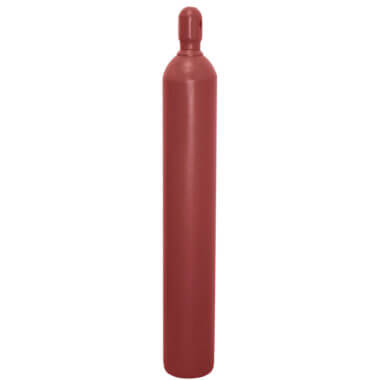
New 300 cuft Steel Argon Cylinder
New 300 cuft Steel Helium Cylinder
New 300 cuft Steel Neon Xenon Cylinder
New 300 cuft Steel Nitrogen Cylinder
FREQUENTLY ASKED QUESTIONS
▼ What argon tank sizes are available and where does 300 cf fit?
Common argon cylinder sizes run 20, 40, 60, 80, 125, and 300 cubic feet, with 300 cf being the largest standard size sold for shop use. It is chosen by fabrication shops and production welders who would otherwise be refilling a smaller bottle every week. Smaller sizes remain the better choice where the cylinder must be carried or moved often.
▼ How long does a 300 cf argon bottle last?
At a typical 20 CFH flow rate a 300 cf argon cylinder gives roughly 15 hours of continuous arc time. Real-world life is far longer than that because gas only flows while the torch is triggered. A busy one-person shop commonly runs one for several weeks.
▼ How tall and heavy is a 300 cf argon cylinder?
A 300 cf steel argon cylinder is the full-height shop bottle and is heavy enough that it should be moved with a cylinder cart rather than carried. It is not a portable size and it will not fit inside most passenger vehicles upright. Anyone needing to transport gas regularly should look at the 80 cf or 125 cf sizes instead.
▼ Is an argon bottle the same as an argon tank or argon cylinder?
Yes, all three terms describe the same product. “Bottle” and “tank” are the common trade and consumer terms, while “cylinder” is the formal DOT and industry designation. Suppliers list the same item under all three names.
▼ Is it cheaper to own a 300 cf argon cylinder or lease one?
Owning becomes cheaper than leasing surprisingly quickly, because a leased cylinder carries rental or demurrage charges every month whether or not it is used. Buying outright means paying only for the gas at each refill. Owners can also refill at whichever supplier is cheapest rather than being tied to the leasing company.
▼ Can a 300 cf cylinder be filled with argon/CO2 mix instead of pure argon?
Yes. The cylinder and its CGA580 valve are suitable for argon, argon/CO2 mixes, nitrogen, and helium, so the same bottle can be refilled with a shielding mix for MIG welding steel. Tell the filling supplier which gas is wanted; the cylinder does not need to be changed.
▼ What regulator does a 300 cf argon tank need?
It needs a regulator with a CGA580 inlet connection, which is the standard fitting for argon and other inert gases. The regulator is a separate purchase and is not included. A flowmeter-style regulator is preferred for welding, since it sets gas flow in CFH rather than pressure.
▼ What is the difference between the 300 cf and 125 cf argon cylinder?
The 300 cf holds roughly two and a half times the gas, so it is refilled far less often, but it is also substantially taller and heavier. The 125 cf remains movable by one person with a cart; the 300 cf is effectively a fixed shop bottle. Weld quality is identical from either.
▼ Does the argon cylinder ship full?
No, it ships empty. Compressed gas cannot travel by standard freight or parcel service under hazardous materials rules, so the cylinder is sent empty with the valve installed and filled at a local gas supplier. This applies to every cylinder sold, from every supplier.
▼ How is a large argon cylinder secured safely in a shop?
Chain or strap the cylinder to a wall, bench, or cylinder cart so it cannot tip, and keep the protective cap fitted whenever the regulator is off. A 300 cf cylinder stores a large volume of gas at high pressure, and a snapped valve on an unsecured bottle is the main hazard. Store upright and away from welding sparks and heat.